First Trip · guide
Buda and Pest, Explained
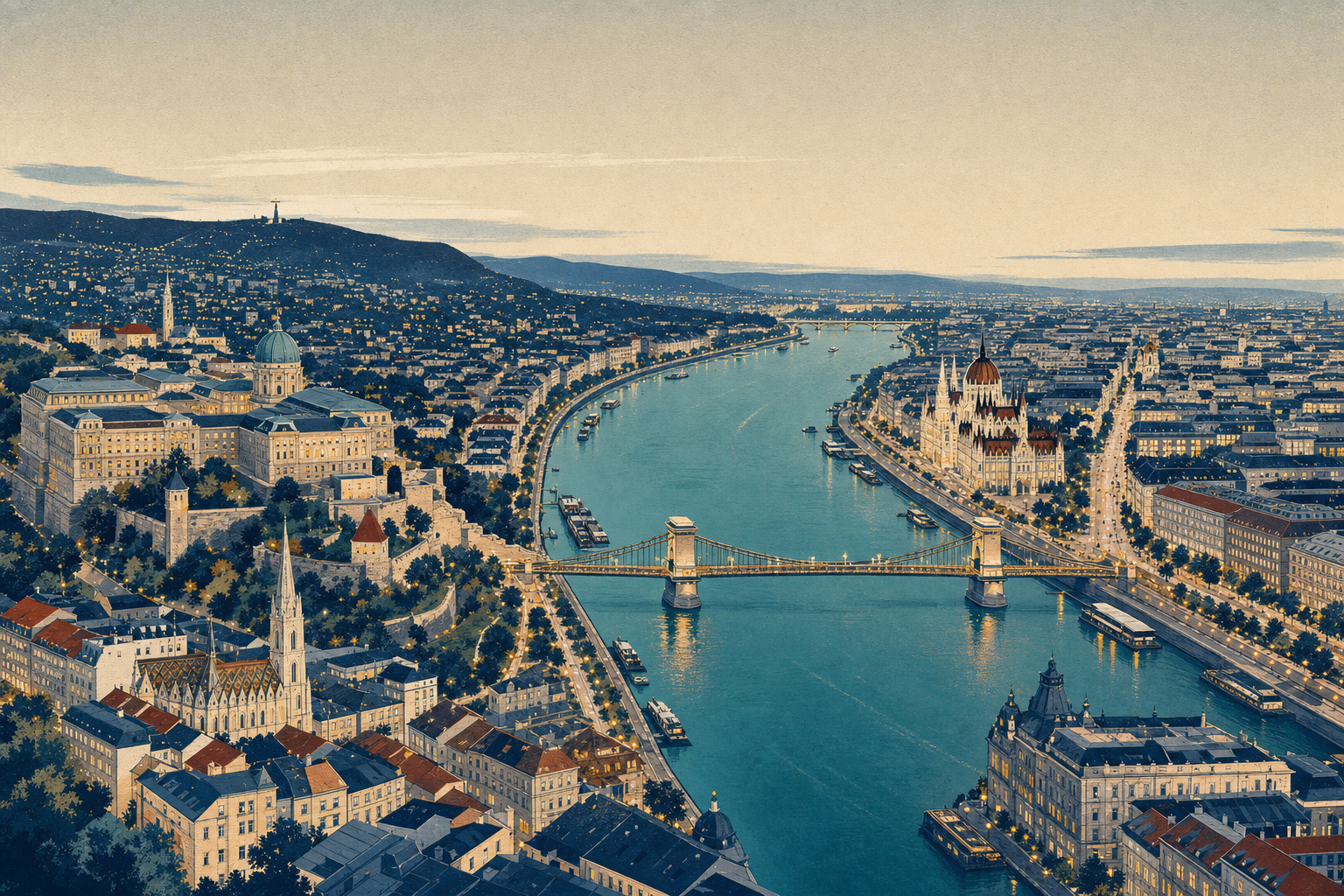
Use the Danube, Buda’s hills and Pest’s plain to understand Budapest before choosing neighbourhoods, hotels and daily routes.
Places, with bearings
Keep the city in view
Use the map for orientation, then use the linked guide and official sources for the decision that matters.
Mapped places
- Hungarian Parliament Building
Danube-side landmark with a separate Visitor Centre route. Use the official booking and visitor information before building a timed visit around it.
Open in OpenStreetMap ↗ - Buda Castle Palace District
Palace and hilltop district with changing works, routes and visitor conditions. Choose one anchor and confirm the current approach before travelling uphill.
Open in OpenStreetMap ↗ - Széchenyi Thermal Bath
City Park thermal bath. Confirm the operator’s current entry, pool and access conditions, then use BudapestGO for the live arrival and return route.
Open in OpenStreetMap ↗
Map data © OpenStreetMap contributors · Tiles © OpenFreeMap
The short version
What matters
- Buda is hillier and more residential; Pest is flatter, denser and more continuous.
- The Danube connects the city and gives every route a reference point.
- The three historic cities united as Budapest in 1873, but their character still matters.
01
The simplest map: hill, river, plain
Start with the physical city. West of the Danube, Buda rises into hills with the Castle District, Gellért Hill and residential slopes. East of the river, Pest spreads across flatter ground with denser boulevards, major shopping and cultural streets, the Parliament side, the Jewish Quarter and City Park. The islands belong to the river’s rhythm rather than either bank’s street grid.
This is not a hierarchy. Buda is not automatically quieter or more authentic; Pest is not automatically easier or less beautiful. The difference is a planning tool. A hill view may ask more walking and vertical movement. A central Pest route may make it easier to link several interiors, cafés and evening venues on foot.
Sources: unesco-budapest, budapestinfo-welcome
02
Why the distinction survived unification
UNESCO’s historical account notes that Buda and Pest were separate cities before their 1873 unification, and it describes how the river, hills, bridges and different urban structures remain legible in the modern capital. That helps explain why a visitor can cross one bridge and feel the day’s texture change.
Pest’s broad, ring-and-radial streets and Buda’s more topographic routes are not trivia. They shape travel time, accommodation choices, where a view appears, and whether a plan works well for someone who prefers level walks or step-free connections. Treat the crossing as part of the itinerary, not a nuisance between pins.
Sources: unesco-budapest
03
Use the Danube as your reference line
Before learning district names, learn where the river sits in relation to you. If you can tell whether you are moving toward the Danube, away from it, uphill or across it, most first-trip navigation becomes less mysterious. The bridges are not just landmarks; they are decisions about what kind of route you are beginning or ending.
On a map, use the river to find the major visual anchors: hilly Buda on the west, flatter Pest on the east, and the islands in the middle of the water’s geography. Then stop trying to memorise the entire city at once. A visitor only needs a working mental map for today’s accommodation, one main area and the return route.
Sources: unesco-budapest, budapestinfo-welcome
04
Read Buda as terrain before attraction names
Buda often rewards a slower, more deliberate route. Hills, historic lanes and viewpoints can make a short distance feel longer than it looks in a street grid, particularly in heat, rain, after dark or when you are carrying luggage. A Buda day can be wonderful precisely because it is less continuous; plan it around one area, one view or one interior rather than assuming every nearby pin belongs in the same walk.
This does not mean Buda is only for strenuous visitors. It means the access and transport choice deserves to be made before you start climbing. Use BKK’s planner for the live route and choose the approach that preserves your energy for the place you wanted to experience, not for proving that you walked the most direct-looking line.
Sources: bkk-go, unesco-budapest, budapestinfo-attractions
05
Read Pest as connected, not flatly simple
Pest’s flatter terrain makes it easier to link central streets, museums, food stops, boulevards, riverfront stretches and evening districts, but it can also invite overplanning. A line that looks compact can become a long day when it includes queues, crossings, shopping stops and repeated decisions about where to eat. Give central Pest a route with a clear beginning, a single main interest and an ending that makes sense for your accommodation.
The advantage is flexibility. If a venue is crowded or your mood changes, another street, café, square or public-space walk may be close by. That ability to substitute is one reason Pest can work well on a first day: you can learn the city’s rhythm without committing the whole day to a single complex transfer.
Sources: budapestinfo-attractions, budapestinfo-welcome
06
Let a bridge give the crossing a purpose
Cross the Danube when the next part of your day belongs on the other side, when the view itself is the point, or when a transport connection makes the crossing useful. Avoid crossing repeatedly merely because the map makes the two banks look close. Each crossing has an opportunity cost in time, energy and the attention needed to enjoy the place you arrive.
A purposeful crossing can be one of the best parts of the trip: a Pest morning leading to a Buda view, a Buda afternoon ending beside the river, or an evening route where the bridge is the transition rather than the obstacle. Leave a little margin around it so the river does not become something you rush past while watching the next reservation.
Sources: unesco-budapest, bkk-go
07
Choose a hotel by the day you want
There is no objectively correct side of the river for a first stay. A Pest base may suit travellers who want a denser, flatter walkable pattern and easy access to central evenings; a Buda base may suit people who value a different pace, a hill or river setting, or a specific nearby interest. The decisive question is how the accommodation connects to your actual list, not whether a guide calls one bank more authentic.
Before booking, draw your arrival route, likely evening return and the first two days. If each requires a complicated crossing, a distant transfer or a difficult final walk, another location may be better even if it appears less glamorous. BKK’s planner can test the connection; your own priorities decide whether the route feels like a benefit or a burden.
Sources: bkk-go, budapestinfo-welcome
08
Give each side its own kind of day
A Buda day might be built around a hill, historic setting, viewpoint, bath or slower residential route; a Pest day might be built around a museum, market, neighbourhood, riverfront sequence, food stop or evening event. These are not rules about what exists where. They are ways to protect the day from turning into repeated cross-city transfers that flatten both experiences into commuting.
Once you have had one day on each side, the distinction becomes useful rather than limiting. You can return to the bank that matches the weather, your interests or your energy. The goal is not to divide Budapest into two separate trips; it is to understand why two parts of one city invite different rhythms.
Sources: unesco-budapest, budapestinfo-attractions
09
Treat district numbers as coordinates, not personalities
Budapest’s 23 districts are useful for an address, a hotel search or a local recommendation, but a number alone is not a visitor itinerary. Start with the broad question—Buda, Pest or an island—and then ask what is actually around the address: the nearest stop, the final walk, the river relationship, the food options and the kind of return you will make after dinner. This keeps a district label from carrying more meaning than it should.
As the trip takes shape, neighbourhood names and landmarks become more useful than administrative boundaries. Your practical map can remain small: accommodation, one or two familiar transport points, the river, a few anchor areas and the route home. That is enough to stop the city from feeling like a scatter of unrelated attraction pins.
Sources: budapestinfo-welcome, bkk-go
10
Match transport to the shape of the bank
On flatter central routes, walking may join several nearby choices more pleasantly than a series of short rides. In Buda, a vehicle connection can protect the part of the day that is actually important, especially when a hill, weather, luggage or limited energy changes the equation. Neither choice is morally better; the good choice is the one that leaves you able to enjoy the destination.
Check BKK’s official planner close to travel for the route that exists at the time you need it. Use it to compare a direct connection with a scenic but longer walk, and keep a simple alternative if an evening, event or changing condition makes the first plan less attractive. The river is a reference line, but public transport is what lets the whole city remain one visit.
Sources: bkk-go, bkk-tickets
11
Let access needs change the first choice
Terrain is not a decorative detail when a step-free route, lift, low-floor vehicle, reliable seating interval or manageable surface is essential. A Buda view may still be the right priority, but it deserves a route-specific check before it becomes the day’s promise. BKK’s accessibility information and individual venues are the sources for live operational details; this guide can only help you see where those questions matter most.
Pest’s flatter pattern may be useful for one traveller, while another may prefer a Buda base because a verified attraction or calmer route fits their needs better. Avoid broad claims that one side is accessible and the other is not. Plan from the exact movement, entrance and return route that will make your own day workable.
Sources: bkk-accessibility, bkk-go, budapestinfo-attractions
12
Use weather to choose the order
A clear, cool morning may be the right moment for a Buda hill or long river crossing; heat, rain or strong wind may make a flatter Pest interior, a café sequence or a shorter public-transport day more sensible. This is not a reason to abandon one side of the city. It is a reason to let conditions decide which texture belongs first.
Keep each day reversible. If the weather changes, retain the main interest but alter the approach: travel closer, choose a lower viewpoint, cross once instead of twice, or move the outdoor part to another time. Check the current forecast close to the visit; historical climate data explains the setting but cannot decide the conditions of your particular afternoon.
Sources: hungaromet-climate, bkk-go, budapestinfo-attractions
13
Plan evenings from the return route backward
After-dark Budapest may draw you toward a river view, dinner, concert or a central Pest neighbourhood, but decide how the evening ends before deciding how late it needs to run. Check the current BKK connection from the area you are visiting, note the last comfortable walk to the accommodation, and choose whether a second cross-river destination genuinely adds enough to justify the trip.
This is especially helpful if you are staying in Buda and dining in Pest, or the reverse. The return does not have to make the evening smaller; it simply keeps the evening from being governed by a last-minute transfer. A quiet final bridge crossing, a nearby dessert or an early return can all be the correct ending for the day you actually had.
Sources: bkk-go, bkk-tickets, budapestinfo-welcome
14
Use one day to compare, then stop comparing
A first visit can tempt you to decide immediately whether you are a ‘Buda person’ or a ‘Pest person.’ Give the city longer than a first impression. Spend time in a central Pest route, take one deliberate Buda route and notice what each makes easier: views, food, walking, rest, transport, evening pace or a sense of space. The answer may change with the weather or the time of day.
Once you know which texture you prefer, use it to choose the remaining days. Return to a side because it suits the next plan, not because you need to prove a loyalty. Budapest’s charm is partly that both patterns remain legible across the Danube; the trip gets richer when you let them answer different needs.
Sources: unesco-budapest, budapestinfo-attractions
15
A simple first-trip decision check
Before adding a stop, ask five questions: Which bank is it on? What is the river crossing, if any? Is the approach level or hilly? What is the closest useful transport connection? What will I do if weather, queues or energy change the plan? If you can answer those, the route is usually ready to try even if you do not yet know every street name.
That is the practical value of understanding Buda and Pest. It turns Budapest from a list of sights into a city whose routes make sense. Use the official operator for live transport and venue details, then let the hill, river and plain give your first trip its bearings.
Sources: bkk-go, budapestinfo-attractions, unesco-budapest
16
Use arrival to learn one side first
On the first afternoon, avoid trying to prove you understand both banks. Travel to the accommodation, take a short route in the immediate area, find the nearest useful transport point and locate the river only if it is naturally nearby. That first small map is enough. A tired arrival day is a poor time to judge whether Buda or Pest is better for you.
The next morning, use the clear mental reference you gained to take a more deliberate route. A simple first evening gives the city a shape, which makes tomorrow’s bridge crossing or neighbourhood choice feel like continuation rather than a fresh navigational test.
Sources: bkk-go, budapestinfo-welcome
17
Keep a low-effort bank in reserve
Every trip benefits from one easy option: a nearby Pest walk, a Buda river view reached without a major climb, a museum or café sequence, or a simple tram connection that lets the city come to you. Keep that route unbooked for the afternoon when the weather, energy or itinerary has stopped cooperating.
A low-effort route is not lesser Budapest. It may be the day you notice the relationship between the river, the bridges and the different scales of the two banks most clearly, because you are no longer trying to cover everything. Use it when it improves the trip, not only when a plan fails.
Sources: bkk-go, unesco-budapest, budapestinfo-attractions
18
Use the sides to plan days, not identities
For a first trip, give central Pest a clear day and give Buda a clear day, then mix as your interests demand. Stay on one side when a compact sequence is working; cross when the river view, a booked activity or an evening destination gives the crossing purpose. That is usually more enjoyable than trying to keep a rigid Buda-versus-Pest scorecard.
Use BKK’s planner for live route details, especially when a hill, a late return or an access need changes the obvious option. Once you know the city’s basic geography, the rest of the guide becomes easier: neighbourhoods are locations with a feel, not a list of unfamiliar district numbers.
Sources: bkk-go, budapestinfo-attractions
Evidence, not footnotes in the dark
Sources
- Budapest World Heritage listingUNESCO World Heritage Centre · checked 9 July 2026
- Budapest welcomes youBudapest Info · checked 9 July 2026
- Budapest attractionsBudapest Info · checked 9 July 2026
- BudapestGOBKK · checked 9 July 2026
- BKK tickets and passesBKK · checked 9 July 2026
- BKK accessible transportBKK · checked 9 July 2026
- Budapest climate data seriesHungaroMet · checked 9 July 2026
- Parliament Visitor Centre and visitor routeOffice of the National Assembly · checked 9 July 2026
- Parliament ticket purchasingOffice of the National Assembly · checked 9 July 2026
- Buda Castle Palace District official informationBudavári Palotanegyed · checked 9 July 2026
- Széchenyi Thermal Bath official informationBudapest Spas · checked 9 July 2026